
Are There Chemical-Free Solutions for Scale Prevention?
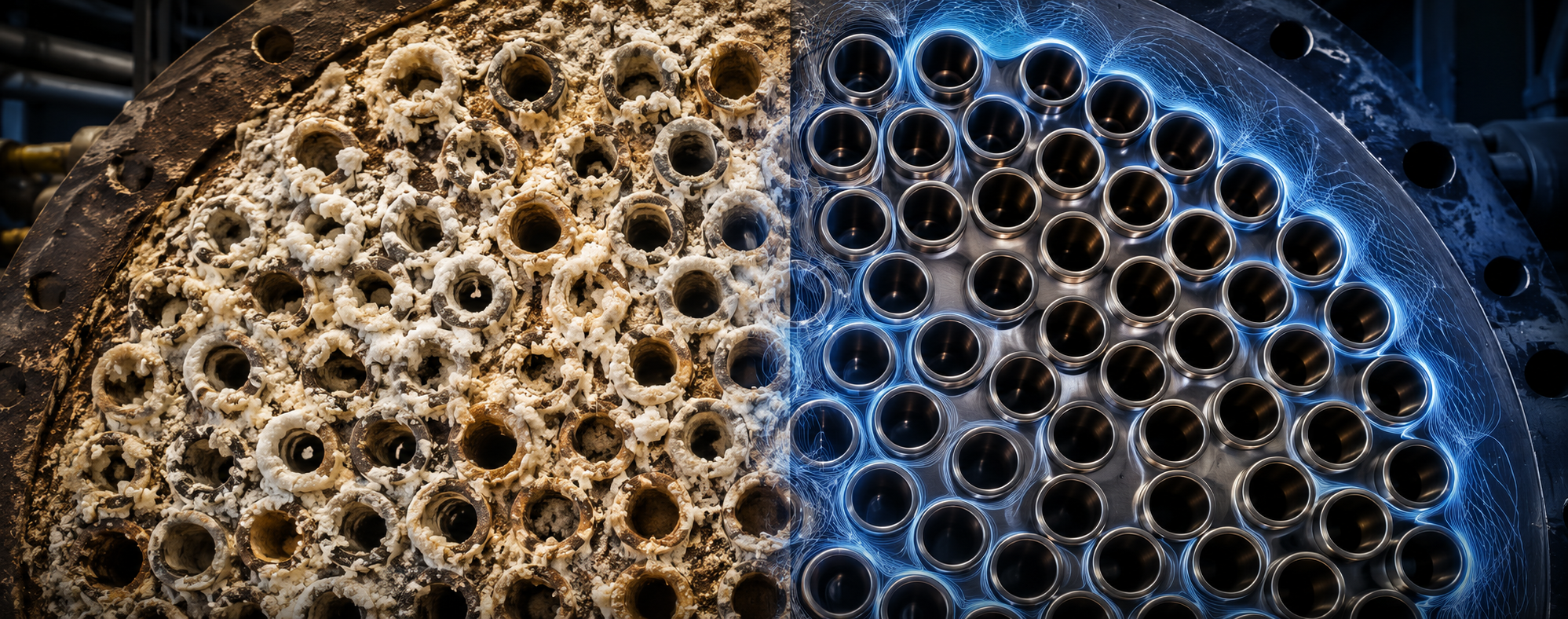
Physics-Based Scale Prevention for Commercial Heat Exchangers
Yes. Scale can be controlled without relying on continuously dosed scale-control chemicals. However, “chemical-free” only describes what a solution does not use—it does not explain how the solution works. Scale Free Systems is more accurately described as physics-based water treatment because it uses controlled physical principles to address the conditions that allow mineral scale to form and bond to equipment surfaces.
For facility managers, building engineers, mechanical contractors, and plant operators, that distinction matters. The goal is not simply to remove chemicals from a treatment program. The goal is to protect critical heat-transfer equipment, maintain efficiency, reduce maintenance, and produce performance that can be monitored and verified.
Why Does Scale Form in Commercial and Industrial Equipment?
Water naturally contains dissolved minerals, including calcium and magnesium. As water is heated, evaporated, or concentrated, those minerals can become more likely to precipitate and attach to internal surfaces.
In cooling towers, boilers, chillers, evaporative condensers, heat exchangers, and process cooling equipment, mineral deposits can build up on the very surfaces responsible for transferring heat. The resulting scale layer acts as insulation between the water and the equipment, which can contribute to:
Reduced heat-transfer efficiency
Increased energy consumption
Restricted water flow
More frequent cleaning and maintenance
Unplanned downtime
Shortened equipment life
Effective scale prevention must do more than temporarily remove visible deposits. It should continuously address the conditions that allow new scale to develop.
What Does “Chemical-Free Scale Prevention” Actually Mean?
The phrase “chemical-free” is commonly used to describe technologies that do not depend on continuous chemical dosing as their primary scale-control mechanism. That may include physical conditioning, filtration, membrane treatment, water softening, operational controls, or a combination of approaches.
These technologies are not interchangeable. Each uses a different mechanism, requires different operating conditions, and produces different results. A product described only as “chemical-free” may still leave several important questions unanswered:
What physical process controls mineral adhesion?
Does the system treat the entire water supply or protect specific equipment?
Can its performance be measured?
Does it prevent new scale, address existing deposits, or both?
How does it respond when water chemistry or operating conditions change?
What monitoring and maintenance are still required?
This is why Scale Free Systems does not rely on “chemical-free” as its primary definition. SFS is physics-based water treatment.
Why SFS Is Better Described as Physics-Based Water Treatment
Traditional scale-control programs generally focus on changing water chemistry through inhibitors, acids, softening, or other treatment processes. Scale Free Systems takes a different approach: it focuses on the physical and electrical conditions inside the equipment where mineral adhesion begins.
SFS technology is engineered to modify the electrical environment at equipment surfaces and influence how dissolved minerals behave in the circulating water. Instead of allowing calcium and magnesium compounds to form hard, insulating deposits on heat-transfer surfaces, the system helps reduce mineral adhesion and keep solids moving with the water stream.
In practical terms, Scale Free Systems is designed to:
Prevent New Scale Formation
Control the surface conditions that encourage minerals to attach and harden before deposits interfere with equipment performance.
Support the Gradual Release of Existing Scale
As the bond between old deposits and equipment surfaces is weakened, existing scale may gradually loosen and leave the system over time.
Preserve Heat-Transfer Efficiency
Cleaner heat-transfer surfaces allow chillers, boilers, heat exchangers, cooling towers, and evaporative condensers to operate more efficiently and predictably.
Reduce Dependence on Continuous Chemical Treatment
Because physics—not continuous chemical dosing—is the primary operating mechanism, facilities may be able to reduce the chemical storage, handling, feed equipment, testing, and downstream discharge associated with conventional programs. The appropriate treatment configuration should always be determined through a site-specific system evaluation.
Physics-Based Treatment Is More Than a “No Chemicals” Claim
The most important difference is the mechanism of action.
Traditional chemical scale control: Changes the chemistry of the circulating water to delay precipitation, bind minerals, adjust pH, or limit deposit formation.
Scale Free Systems: Applies controlled physics to the conditions within the equipment, helping prevent minerals from bonding to critical surfaces.
That makes “physics-based” a more complete and technically meaningful description than “chemical-free.” It tells engineers and operators what drives the treatment process—not merely what is absent from it.
SFS is also different from passive magnets, external coils, and unmonitored signal devices. It is designed as an equipment-level protection system with controllable operation and measurable system performance.
Does Physics-Based Mean No Testing or Maintenance?
No. No responsible water-treatment strategy should be presented as “install it and forget it.” System conditions still matter, including:
Makeup-water chemistry
Temperature and heat load
Cycles of concentration
Flow rate and blowdown control
Equipment metallurgy
Existing scale, sediment, and corrosion
Filtration and mechanical condition
Microbiological risk and applicable water-management requirements
Scale prevention is one part of responsible system management. Cooling towers and other aerosol-generating systems must continue to follow an effective site-specific water-management plan, including the monitoring, cleaning, testing, documentation, and corrective actions required for the facility.
Where Can Scale Free Systems Be Applied?
Scale Free Systems provides physics-based protection for commercial and industrial heat-transfer equipment, including:
Cooling towers
Chillers and condenser-water systems
Boilers
Evaporative condensers
Heat exchangers
Process cooling systems
Storage tanks
Each application should begin with an evaluation of the equipment, water source, operating conditions, current treatment program, and performance goals.
How Should a Facility Evaluate a Non-Chemical Scale Solution?
Before selecting any scale-prevention technology, ask the provider to explain:
The mechanism: What specifically prevents minerals from attaching to equipment?
The application: Which equipment and operating conditions is the system designed to protect?
The measurements: How will scale, water use, energy use, corrosion, and system performance be monitored?
The limitations: What site conditions could require additional treatment or operational changes?
The service plan: Who inspects, maintains, documents, and optimizes the system after installation?
A credible solution should be evaluated by its mechanism, engineering fit, monitoring, and results—not by the phrase “chemical-free” alone.
The Bottom Line
Are there chemical-free solutions for scale prevention? Yes—but the better question is how the technology controls scale and how its performance is verified.
Scale Free Systems is best described as a physics-based water-treatment solution. Rather than continually changing water chemistry, SFS treats the conditions inside the equipment where scale begins. The objective is cleaner heat-transfer surfaces, more reliable operation, lower maintenance demands, and reduced dependence on traditional chemical treatment programs.
Find Out Whether Physics-Based Scale Prevention Fits Your System
If your facility is dealing with recurring scale, rising chemical costs, lost heat-transfer efficiency, excessive water use, or repeated equipment cleaning, Scale Free Systems can evaluate the application and identify where physics-based treatment may improve performance.
Frequently Asked Questions
Can scale be prevented without chemicals?
Some commercial and industrial systems can control scale without relying on continuously dosed scale-control chemicals. Results depend on the treatment mechanism, source-water chemistry, heat load, cycles of concentration, equipment design, and operating practices.
Is Scale Free Systems a water softener?
No. A conventional water softener removes or exchanges hardness minerals before the water enters the equipment. SFS does not depend on softening the entire water supply. It uses physics to address the conditions that allow minerals to attach to protected equipment surfaces.
Can SFS remove existing scale?
Scale Free Systems is designed to prevent new mineral adhesion and support the gradual release of existing scale. The rate and extent of scale reduction depend on deposit composition, thickness, equipment condition, water chemistry, and system operation.
Can SFS replace an existing chemical-treatment program?
In suitable applications, SFS may reduce or replace reliance on traditional scale-control chemistry. The appropriate transition must be based on a site evaluation and coordinated with the facility’s water-management, safety, monitoring, and regulatory requirements.
Does physics-based water treatment require maintenance?
Yes. SFS is designed for low-maintenance operation, but the treatment system and protected equipment should still be inspected, monitored, documented, and serviced according to the facility’s operating plan.
Is SFS the same as a magnetic or coil-based conditioner?
No. Scale Free Systems is not a passive magnet or external coil device. It is an engineered, equipment-level system designed to apply controlled physics and provide measurable operation.
