
Legionella Control for Cooling Towers | Scale Free Systems
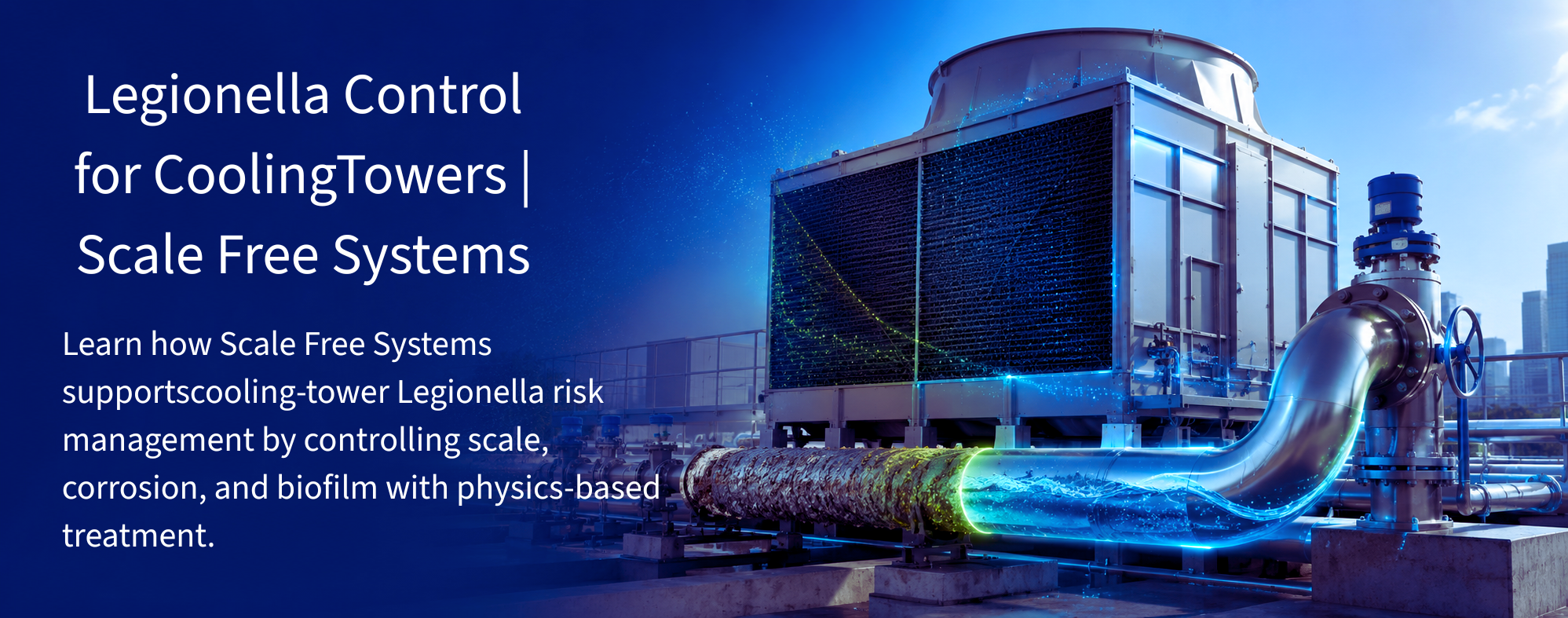
Legionella Control in Cooling Towers: A Physics-Based Approach to Managing the Conditions Behind the Risk
Legionella control in cooling towers requires more than adding a product to the water and assuming the problem is solved. It requires a documented, actively managed program that addresses the conditions that allow bacteria to survive, multiply, and spread.
Cooling towers deserve particular attention because they combine warm water, airflow, nutrients, and aerosol generation. When scale, corrosion products, sediment, or biofilm accumulate inside the system, they can create protected environments where microorganisms become harder to control.
That is why Scale Free Systems takes a different approach to commercial and industrial water treatment. Instead of relying solely on continuous chemical dosing, SFS applies physics-based equipment conditioning to help control scale, slow corrosion, inhibit biological growth, and maintain cleaner heat-transfer surfaces.
The objective is not simply to treat the water. It is to control the system conditions that influence performance, cleanliness, and biological activity.
Why Cooling Towers Can Become a Legionella Risk
Legionella is a waterborne bacterium that can cause Legionnaires’ disease, a serious form of pneumonia. Exposure may occur when contaminated water becomes aerosolized and small droplets are inhaled. Because cooling towers reject heat by moving air through recirculating water, poorly managed towers can become a potential source of exposure.
The presence of water alone is not the entire problem. Risk increases when several favorable conditions develop together:
- Warm water temperatures
- Low-flow areas, dead legs, or periods of stagnation
- Inadequate disinfectant residual
- Sediment and organic debris
- Mineral scale on internal surfaces
- Corrosion products that supply nutrients and create rough attachment sites
- Biofilm that shelters microorganisms from treatment
- Inconsistent inspection, cleaning, testing, or corrective action
The CDC identifies sediment and biofilm, temperature, water age, and disinfectant residual as key factors affecting Legionella growth in cooling towers. It also emphasizes that scale control, corrosion control, system cleaning, and a managed disinfectant residual are important parts of cooling-tower operation.
In other words, effective Legionella risk management is a system-level responsibility—not a single-product decision.
## The Hidden Role of Scale, Corrosion, and Biofilm
Scale, corrosion, and microbiological growth are often treated as separate maintenance problems. Inside operating HVAC equipment, however, they can reinforce one another.
Mineral scale creates rough, insulating surfaces where debris can collect. Corrosion produces deposits and irregular surface conditions that may provide additional attachment sites and nutrients. Biofilm can then develop across those surfaces, trapping more material and shielding microorganisms from treatment.
This cycle can affect both safety and performance:
- Biofilm and scale insulate heat-transfer surfaces.
- Reduced heat transfer forces equipment to work harder.
- Deposits can restrict flow and create low-circulation zones.
- Under-deposit corrosion can shorten equipment life.
- Protected microorganisms may become more difficult to reach with disinfectants.
- Maintenance, water use, energy consumption, and operating costs can increase.
A credible cooling-tower water-treatment strategy should therefore address the physical condition of the equipment as well as the chemistry of the circulating water.
## Why Chemical Treatment Alone Can Leave Operational Gaps
Oxidizing and non-oxidizing disinfectants remain part of many cooling-tower water-management programs, and emergency remediation may require
specific disinfection procedures. The limitation is not that chemistry never works. The limitation is assuming that chemical feed alone controls every condition inside a dynamic mechanical system.
Chemical programs can lose effectiveness when:
- Feed pumps, tubing, probes, or controllers malfunction
- Water chemistry changes faster than the dosing program responds
- pH moves outside the effective range of the selected disinfectant
- Scale or biofilm limits contact with protected surfaces
- Blowdown, makeup water, or cycles of concentration are poorly managed
- Treatment is interrupted during shutdown, standby, or service
- Monitoring identifies a deviation but corrective action is delayed
Adding more treatment does not automatically correct deposits, surface conditions, poor circulation, or equipment-level instability. A more complete strategy reduces the conditions that create biological shelter while also maintaining the monitoring, cleaning, and disinfection controls required by the facility’s water-management program.
How Scale Free Systems Supports Legionella Risk Management
Scale Free Systems is a physics-based water-treatment technology designed for cooling towers, chillers, boilers, evaporative condensers, heat exchangers, storage tanks, and other commercial or industrial heat-transfer equipment.
SFS treats the equipment environment—not just the water passing through it. Its approach combines control of the electrical conditions associated with mineral adhesion and corrosion with targeted ionization for biological control where required.
1. Helps Prevent and Release Mineral Scale
SFS modifies the electrical environment at equipment surfaces to disrupt the conditions that allow dissolved minerals to form hard deposits.
Minerals are encouraged to remain in suspension rather than bonding to heat-transfer surfaces, while existing scale can gradually release over time.
Cleaner surfaces mean fewer rough, protected areas where sediment and biological material can accumulate. They also support more efficient heat transfer and easier inspection and maintenance.
2. Controls the Electrical Drivers of Corrosion
Corrosion is an electrochemical process. SFS is designed to reduce the electrical activity that drives that process, helping slow metal loss and limit the corrosion products that can collect throughout a system.
Controlling corrosion supports longer equipment life, but it also contributes to cleaner system conditions. The CDC specifically identifies corrosion control as part of effective Legionella risk management in cooling towers.
3. Inhibits Biofilm and Biological Growth
Biofilm is more than slime on a surface. It is a protective structure that can shelter bacteria and reduce direct contact with disinfectants. SFS supports biological control by reducing the scale and corrosion conditions that encourage fouling and by applying controlled copper-silver ionization where appropriate.
Copper-silver ionization is among the Legionella-control technologies reviewed by the U.S. Environmental Protection Agency for premise-plumbing applications. As with any treatment technology, performance depends on proper engineering, operation, water chemistry, monitoring, and validation for the specific application.
4. Provides Measurable, Monitored System Control
SFS is not a magnet, passive coil, or unmonitored signal device. The system is engineered with active controls and measurable operating parameters so performance can be evaluated rather than assumed.
According to Scale Free Systems, one independently tested cooling-tower water sample from an SFS installation measured 329 colony-forming units per milliliter for general bacterial activity. That result is a useful system-performance indicator, but it is not a substitute for Legionella-specific testing or for the verification and validation procedures established by a facility’s water-management team.
Physics-Based Does Not Mean “Ignore Chemistry
Scale Free Systems is best described as physics-based—not simply “chemical-free.� That distinction matters.
SFS changes the physical and electrical conditions inside the equipment so facilities can reduce dependence on continuous chemical treatment while addressing scale, corrosion, and biological growth at their source. However, Legionella risk management must remain site-specific.
Depending on the facility, equipment, operating conditions, applicable regulations, and water-management plan, additional disinfectant residuals, testing, cleaning, or corrective treatment may still be required. A suspected case or outbreak requires coordination with the appropriate public-health authority and qualified water-treatment professionals. SFS should never be presented as a replacement for emergency cleaning and disinfection protocols.
That is not a weakness in the SFS approach. It is what responsible water management looks like: use the right technology for the right function, measure actual performance, and act when established control limits are not met.
## Building a Stronger Cooling-Tower Water-Management Program
ASHRAE Standard 188 establishes minimum requirements for managing legionellosis risk in building water systems, while ASHRAE Guideline 12 provides system-specific guidance. A well-run program typically includes:
1. A designated water-management team with clearly assigned responsibilities
2. A current diagram and description of the building water systems
3. Identification of areas where hazardous conditions may develop
4. Control measures and measurable control limits
5. Routine monitoring and documentation
6. Predetermined corrective actions when limits are not maintained
7. Verification that the program is being implemented and validation that it is controlling risk
Within this framework, SFS can serve as the equipment-conditioning component that helps maintain cleaner surfaces, control mineral adhesion, slow corrosion, and inhibit biological growth. Routine inspection, cleaning, monitoring, and testing remain essential.
What Facility Managers and Mechanical Contractors Should Evaluate Before selecting or modifying a cooling-tower treatment program, ask:
- Is scale still forming despite the current treatment program?
- Are corrosion rates, tube failures, or metal replacement costs increasing?
- Is biofilm repeatedly returning after cleaning or biocide treatment?
- Are chemical pumps, probes, and feed systems reliable and consistently calibrated?
- Does the program address low-flow areas, shutdowns, standby equipment, and seasonal startup?
- Are control limits documented and routinely recorded?
- Does the facility have predetermined corrective actions for out-of-range results?
- Can the treatment provider show measurable equipment and biological performance?
- Is the program reducing risk while also protecting heat-transfer efficiency and equipment life?
If the current program focuses only on chemical concentration and not on equipment conditions, the system may be treating symptoms while leaving important physical drivers in place.
A More Complete Approach to Cooling-Tower Protection
Legionella risk cannot be managed by marketing claims or by installing a single device. It requires disciplined water management, qualified oversight, measurable control, and equipment that is maintained in a condition that does not encourage biological growth.
Scale Free Systems adds a valuable layer to that strategy by addressing the interconnected problems of scale, corrosion, and biofilm through system physics. The result is a cleaner, more stable operating
environment with the potential for lower chemical dependency, improved heat-transfer efficiency, reduced maintenance, and longer equipment life.
For facility managers, plant operators, building owners, and mechanical contractors, the question is not simply, What are we adding to the water?
The better question is, Are we controlling the conditions inside the equipment?
Schedule a Scale Free Systems Evaluation
If your cooling towers, chillers, boilers, or evaporative condensers continue to experience scale, corrosion, biofilm, inconsistent treatment performance, or rising chemical costs, Scale Free Systems can evaluate the equipment, operating conditions, and current water-treatment approach.
Schedule a system evaluation to determine whether physics-based equipment conditioning can strengthen your facility water-management strategy.
