
Can Scale Free Systems’ Technology Help Reduce Energy Costs for Industrial Facilities?
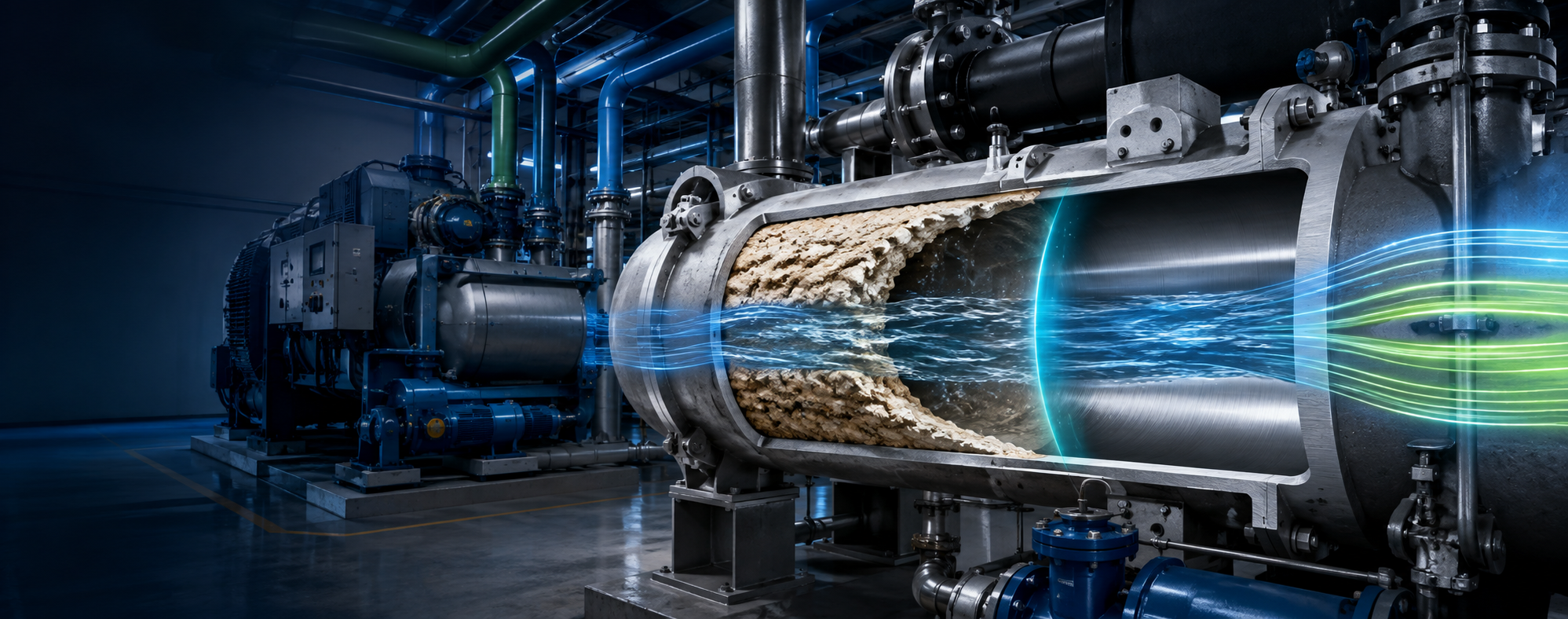
Yes. Scale Free Systems’ physics-based water treatment technology can help industrial facilities reduce energy costs by controlling the scale, corrosion, and biological fouling that interfere with heat transfer and force critical equipment to work harder.
Cooling towers, chillers, boilers, evaporative condensers, and heat exchangers operate most efficiently when their heat-transfer surfaces remain clean. Even a relatively thin layer of mineral scale or biological buildup can act as an insulating barrier, reducing efficiency and increasing the amount of energy required to maintain the desired operating temperature.
Why Water Treatment Affects Industrial Energy Costs
Industrial HVAC and process-water equipment depends on efficient heat exchange. When mineral deposits, corrosion products, or biofilm accumulate on equipment surfaces, they restrict heat transfer between the water and the system.
The resulting efficiency loss can cause:
Chillers and compressors to run longer
Boilers to consume more fuel
Pumps and fans to work harder
Condenser temperatures and pressures to increase
Production equipment to operate less efficiently
Maintenance requirements and unplanned downtime to rise
Traditional water treatment programs may manage water chemistry without fully eliminating the surface conditions that allow these problems to develop. Scale Free Systems takes a different approach.
How Scale Free Systems Supports Energy Efficiency
Scale Free Systems uses physics-based technology to influence the electrical conditions associated with mineral adhesion, corrosion, and biological attachment on equipment surfaces.
Rather than relying solely on chemical treatment, SFS helps condition the protected equipment continuously. This approach is designed to address the conditions that contribute to deposits and fouling where they matter most: on heat-transfer surfaces.
By helping maintain cleaner equipment surfaces, Scale Free Systems can support:
More efficient heat transfer
Lower chiller and compressor workloads
Reduced boiler fuel consumption
Improved condenser performance
More stable operating temperatures
Longer equipment service life
Less energy lost to scale and biological fouling
Reducing Scale to Improve Heat Transfer
Mineral scale is a poor conductor of heat. When it forms inside condenser tubes, boiler tubes, heat exchangers, or associated piping, the equipment must use additional energy to achieve the same heating or cooling output.
Scale Free Systems is designed to prevent new scale from firmly adhering to protected surfaces while helping existing deposits gradually loosen under normal system operation. Maintaining cleaner heat-transfer surfaces can help restore system performance and reduce unnecessary energy consumption.
Controlling Corrosion and Biological Fouling
Scale is not the only water-related condition that affects energy efficiency. Corrosion products can create rough surfaces that collect additional deposits and restrict water flow. Biological fouling can also form an insulating layer that reduces heat transfer.
SFS technology is engineered to help control all three major equipment threats:
Mineral scale
Corrosion
Biological growth and surface attachment
Addressing these related conditions through one continuous equipment-protection strategy can improve operating consistency while reducing maintenance demands.
What Industrial Equipment Can Benefit?
Scale Free Systems can support energy-efficiency initiatives involving commercial and industrial equipment such as:
Cooling towers
Water-cooled chillers
Boilers
Evaporative condensers
Heat exchangers
Condenser-water systems
Process-water equipment
Storage tanks and associated piping
Applications should be evaluated individually because equipment design, operating load, existing deposits, water quality, system controls, and maintenance practices can all influence the results.
Additional Opportunities for Operational Savings
Improved heat-transfer efficiency is only one potential source of savings. Better control of scale, corrosion, and biological fouling may also help facilities reduce:
Mechanical cleaning requirements
Emergency repair expenses
Equipment downtime
Premature component replacement
Water consumption and sewer charges
Dependence on traditional chemical treatment
Labor associated with water-treatment maintenance
These improvements can lower the facility’s total cost of operation, even when the direct energy savings vary between applications.
How Are Potential Energy Savings Determined?
The best way to estimate savings is to evaluate the facility’s current operating conditions and establish a performance baseline.
A professional system evaluation may include:
Existing scale and fouling conditions
Chiller or boiler operating performance
Condenser approach temperatures
Energy and water consumption
Equipment runtime and load
Maintenance and cleaning history
Current chemical-treatment costs
Water quality and system design
Performance can then be monitored after installation using relevant operating data, utility consumption, maintenance records, and equipment inspections.
Is Scale Free Systems Chemical-Free?
Scale Free Systems is more accurately described as physics-based water treatment—not simply chemical-free water treatment.
The technology addresses physical and electrical conditions at the equipment level instead of depending exclusively on chemical reactions within the water. Depending on the application and regulatory requirements, SFS may supplement an existing treatment program or help reduce reliance on certain chemicals.
Any microbiological treatment program must still follow applicable regulations, operating requirements, and the facility’s water-management plan.
A More Efficient Approach to Industrial Water Treatment
For many industrial facilities, reducing energy consumption begins with keeping heat-transfer equipment clean and operating efficiently.
Scale Free Systems provides a physics-based approach to controlling scale, corrosion, and biological fouling in cooling towers, chillers, boilers, evaporative condensers, and heat exchangers. By protecting the surfaces responsible for heat transfer, SFS can help facilities improve equipment performance, reduce operating costs, and extend asset life.
Schedule a Scale Free Systems Evaluation
The amount of energy and operational savings available depends on your equipment, water conditions, operating load, and current treatment program.
Schedule a system evaluation with Scale Free Systems to identify water-related efficiency losses and determine whether physics-based treatment is appropriate for your facility.
